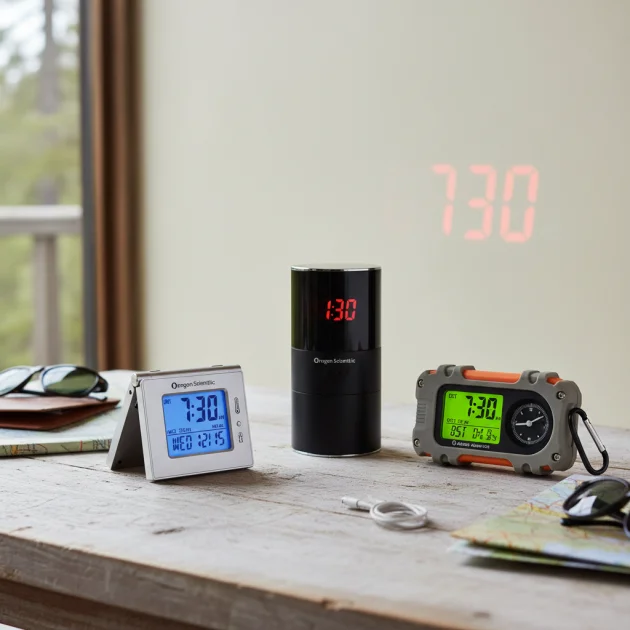
The Oregon Scientific RM338P Projection Alarm Clock is the best Oregon Scientific alarm clock for travel due to its compact design, clear projection feature, and reliable timekeeping. This model ensures punctual awakenings on the go, making it an ideal travel companion for various trips.
Quick comparison
| Model | Key Feature | Portability | Battery Life |
|---|---|---|---|
| Oregon Scientific RM338P | Projection Time | Excellent | Good |
| Oregon Scientific RMR221P | Indoor/Outdoor Temp | Very Good | Excellent |
| Oregon Scientific BAR208HG | Atomic Time | Good | Very Good |
What travel needs from an alarm clock
A travel alarm clock must prioritize portability, durability, and ease of use. Compact dimensions and a lightweight build are essential for minimizing luggage bulk and weight. Battery operation is crucial, offering independence from power outlets that may be scarce or incompatible in different regions. Long battery life ensures consistent performance throughout extended trips without frequent replacements. Durability is also key; the clock should withstand minor impacts and temperature fluctuations common during travel. Clear, legible displays are important, especially in varying light conditions. Additional features like a snooze function, backlight, and simple alarm setting enhance user convenience. Some travelers benefit from atomic time synchronization for automatic time zone adjustments, eliminating manual resets. A protective case or robust construction prevents damage during transit. The alarm volume should be sufficient to wake users without being overly disruptive to others in shared accommodations. Ultimately, a travel alarm clock needs to be a reliable, unobtrusive tool that ensures timely departures and appointments, regardless of location.
Detailed reviews
Oregon Scientific RM338P Projection Alarm Clock
The Oregon Scientific RM338P Projection Alarm Clock stands out for its innovative time projection feature, making it highly convenient for travel. Its compact, sleek design easily fits into any travel bag without adding significant weight. The clock projects the time onto a wall or ceiling, allowing users to check the time without fumbling for glasses or turning on a light. This is particularly useful in unfamiliar hotel rooms. It operates on batteries, ensuring portability and independence from power outlets. The display is clear and easy to read, even without the projection. Setting the alarm is straightforward, with intuitive buttons. The snooze function provides extra sleep flexibility. While primarily designed for bedside use, its small footprint and robust build quality make it a reliable travel companion. The projection angle is adjustable, enhancing usability in various room layouts. Priced around $35, it offers excellent value for its unique functionality and travel-friendly design.
Oregon Scientific RMR221P Indoor/Outdoor Temperature Projection Clock
The Oregon Scientific RMR221P offers more than just timekeeping, making it a versatile travel alarm clock for those who appreciate environmental data. This model features both indoor and outdoor temperature readings, projected onto a surface alongside the time. While the outdoor sensor might be less critical for short trips, the indoor temperature is useful for adjusting room comfort. Its design is still relatively compact, though slightly larger than the RM338P due to the added features. It operates on batteries, providing essential portability. The display is clear and backlit, ensuring readability in various lighting conditions. The alarm function is reliable, and the setup process is user-friendly. The projection feature, like its sibling, is a significant advantage for quick time checks in the dark. Its robust construction ensures it can handle the rigors of travel. Priced around $45, it caters to travelers who desire additional environmental information alongside their alarm clock functionality.
Oregon Scientific BAR208HG Advanced Weather Station with Atomic Time
The Oregon Scientific BAR208HG, while more of a weather station, includes a highly reliable atomic alarm clock function that benefits travelers. Its atomic time synchronization ensures precise timekeeping, automatically adjusting for time zones and daylight saving, which is invaluable when moving between locations. The unit is larger than typical travel clocks but remains manageable for those who prioritize accuracy and additional data. It provides indoor and outdoor temperature and humidity, offering comprehensive environmental awareness. The display is large and easy to read, with a backlight for night viewing. It operates on batteries, maintaining its portability. The alarm is clear and effective, with a snooze option. While its primary focus is weather monitoring, its atomic clock feature makes it a strong contender for travelers who demand absolute time accuracy and appreciate detailed environmental information. Priced around $60, it’s an investment for the data-conscious traveler.
Routine fit
An Oregon Scientific alarm clock seamlessly integrates into various travel routines, from business trips to leisure vacations. For the business traveler, models like the RM338P ensure punctual awakenings for early meetings, with the projection feature allowing discreet time checks without disturbing a travel partner. Its compact size fits easily into a briefcase or carry-on. Leisure travelers benefit from the reliability of these clocks for catching early flights or tours, avoiding the uncertainty of hotel wake-up calls. The RMR221P, with its temperature readings, can help travelers adjust to new climates, ensuring comfort. For those exploring multiple time zones, the atomic synchronization of the BAR208HG eliminates the hassle of manual time adjustments, providing peace of mind. Whether you’re camping, staying in a hostel, or a luxury hotel, an Oregon Scientific travel alarm clock provides a consistent, personal wake-up solution, adapting to diverse environments and ensuring you stay on schedule.
FAQs
How durable are Oregon Scientific travel alarm clocks?
Oregon Scientific travel alarm clocks are generally designed with durability in mind, featuring robust plastic casings that can withstand the typical bumps and jostles of travel. While not indestructible, they are built to be resilient against minor impacts and temperature variations. Models like the RM338P are compact and have fewer delicate moving parts, contributing to their longevity. It is always recommended to pack them securely within luggage, perhaps in a soft pouch, to provide an extra layer of protection against more significant drops or pressure from other items. Their construction focuses on practical, everyday use, making them reliable companions for frequent travelers.
Do Oregon Scientific travel clocks automatically adjust for time zones?
Not all Oregon Scientific travel clocks automatically adjust for time zones. Models with atomic time synchronization, such as the BAR208HG, will automatically receive signals to update the time, including adjustments for time zones and daylight saving. However, more basic travel alarm clocks like the RM338P or RMR221P require manual adjustment when you cross time zones. While this is a simple process, travelers who frequently move between zones might prefer an atomic clock for the convenience of automatic updates. Always check the specific model’s features to confirm atomic time capabilities.
What type of batteries do these clocks use and how long do they last?
Most Oregon Scientific travel alarm clocks typically use common AAA or AA batteries, making replacements easy to find globally. For instance, the RM338P often uses two AAA batteries. Battery life varies significantly depending on usage, especially how often features like backlights or projection are activated. Generally, a set of quality alkaline batteries can last several months to over a year with moderate use. For extended trips, it’s advisable to carry spare batteries. Some models might also have an AC adapter option for home use, but battery power is the primary mode for travel portability.
Are the projection features clear in different lighting conditions?
The projection features on Oregon Scientific clocks, such as the RM338P and RMR221P, are designed for optimal clarity in low-light conditions. They project a sharp, red digital display onto a wall or ceiling, which is highly visible in a dark or dimly lit room. In brighter environments, the projection may become less distinct or even invisible due to ambient light washing it out. The effectiveness of the projection is best tried in typical nighttime settings, making it ideal for checking the time without fully waking up or disturbing others. The focus is on convenience during sleep hours.
Can I use these clocks internationally with different power outlets?
Oregon Scientific travel alarm clocks are primarily battery-operated, which makes them ideal for international travel as they do not rely on local power outlets. This eliminates the need for voltage converters or plug adapters. If a specific model does include an optional AC adapter, it would typically be a low-voltage adapter (e.g., 5V DC) that might require a simple plug adapter for different regions, but not a voltage converter if it’s a universal voltage adapter. For maximum convenience and compatibility across all countries, relying on the battery power is the most straightforward approach.
Verdict
For travelers seeking a reliable and convenient wake-up solution, the Oregon Scientific RM338P Projection Alarm Clock stands out as the best choice. Its compact size, battery operation, and innovative time projection feature make it exceptionally practical for diverse travel scenarios. While other models offer additional features like temperature readings or atomic time synchronization, the RM338P strikes an optimal balance between functionality, portability, and ease of use. It ensures punctual awakenings without adding unnecessary bulk or complexity to your travel essentials, making it an indispensable companion for any journey.
Frequently Asked Questions
How durable are Oregon Scientific travel alarm clocks?
Oregon Scientific travel alarm clocks are designed with robust plastic casings to withstand typical travel bumps and jostles. Models like the RM338P are compact with fewer delicate parts, contributing to their longevity. It is recommended to pack them securely in luggage for added protection.
Do Oregon Scientific travel clocks automatically adjust for time zones?
Not all Oregon Scientific travel clocks automatically adjust for time zones. Models with atomic time synchronization, such as the BAR208HG, update automatically. Basic models like the RM338P require manual adjustment when crossing time zones.
What type of batteries do these clocks use and how long do they last?
Most Oregon Scientific travel alarm clocks use common AAA or AA batteries; for example, the RM338P uses two AAA batteries. Battery life varies, but quality alkaline batteries can last several months to over a year with moderate use. Carrying spare batteries for extended trips is advisable.
Are the projection features clear in different lighting conditions?
The projection features on Oregon Scientific clocks, like the RM338P, are designed for optimal clarity in low-light conditions, projecting a sharp red digital display. In brighter environments, the projection may become less distinct or invisible due to ambient light.
Can I use these clocks internationally with different power outlets?
Oregon Scientific travel alarm clocks are primarily battery-operated, making them ideal for international travel without needing voltage converters or plug adapters. If an AC adapter is optional, it's typically low-voltage and might only require a simple plug adapter.
Get our weekly buyer guide
Practical specs, not advice. Unsubscribe anytime.
The Oregon Scientific BAR208HG is pretty good for keeping accurate time with its atomic sync, which is why I picked it up. My only real complaint is that the battery life isn’t as long as I’d hoped. I had to swap out the batteries sooner than expected on a two-week vacation, which was a bit of a hassle.
I recently got the Oregon Scientific RM338P for a business trip, and it was a lifesaver. The projection feature is super clear, even in a dim hotel room, and it’s so small it barely took up any space in my carry-on. Definitely makes waking up in unfamiliar places a lot easier. Highly recommend it for frequent travelers!
I’ve been using the Oregon Scientific RMR221P for a few months now, mostly for camping trips. The indoor/outdoor temperature display is a neat bonus, especially when you’re trying to gauge how cold it’ll be outside the tent. It’s really durable too, which is a must for my kind of travel. Solid choice for adventurers.